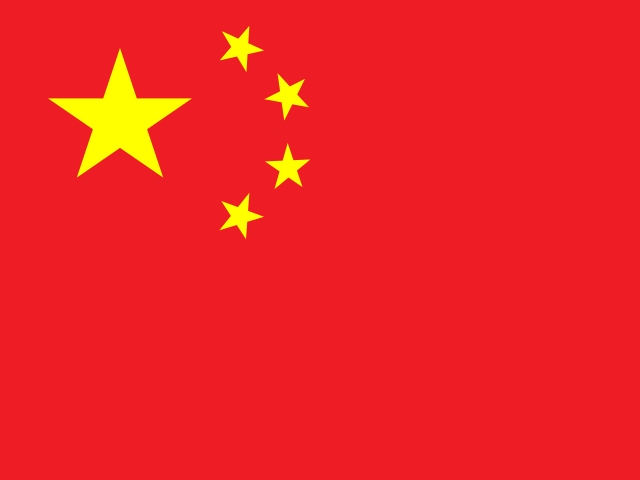
China
People's Republic of China
U.S. sanctions — Chinese military-industrial measures. U.S.-person investment restrictions on designated military-industrial companies; export controls apply broadly.
As of August 2026 — verify with OFAC and screen counterparties with the xin.bz OFAC search.
- Region
- Asia · Eastern Asia
- Capital
- Beijing
- Population
- 1,406,585,000 (2025)
- Government
- communist party-led state
- Currency
- Chinese yuan (CNY)
- Official languages
- Chinese
- Spoken languages
- Standard Chinese or Mandarin (official; Putonghua, based on the Beijing dialect), Yue (Cantonese), Wu (Shanghainese), Minbei (Fuzhou), Minnan (Hokkien-Taiwanese), Xiang, Gan, Hakka dialects
- Written scripts
- Chinese characters
- Area
- 9,706,961 km²
- Coastline
- Coastal
- UN member
- Yes
- Affiliations
- APEC, ASEAN (dialogue partner), BRICS, G20, IMF, SCO, WCO, WTO
- Borders
- Afghanistan , Bhutan , Myanmar , Hong Kong , India , Kazakhstan , Nepal , North Korea , Kyrgyzstan , Laos , Macau , Mongolia , Pakistan , Russia , Tajikistan , Vietnam
Political stability
63 / 100
Economic stability
55 / 100
Population stability
64 / 100
0–100, higher is more stable. Political: World Bank governance score. Economic: government effectiveness, regulatory quality, and inflation proximity to 2% (World Bank). Population: stability of growth and net migration rates (World Bank).
Trade profile
- Key exports
- broadcasting equipment, computers, integrated circuits, garments, machine parts (2023)
- Key imports
- crude petroleum, integrated circuits, iron ore, gold, natural gas (2023)
- Natural resources
- coal, iron ore, helium, petroleum, natural gas, arsenic, bismuth, cobalt, cadmium, ferrosilicon, gallium, germanium
- Critical minerals
- Dominant in rare-earth processing and gallium/germanium; leading graphite supply.
- Luxury goods
- silk, jade, baijiu, fine tea
- Primary route
- Transpacific and Asia–Europe mainlines from Shanghai/Ningbo/Shenzhen
- Secondary route
- China–Europe rail corridors and RCEP intra-Asia network
The xin.bz view
- China is the shock router of the 2026–27 El Niño: grain reserves, rice-for-feed auctions, and 4x sorghum buying absorb crop damage at home, while its purchases decide whether Brazilian or U.S. logistics carry the soybean load.
- It has drawn roughly 400M barrels of crude imports below the prior year — the coming stock-rebuilding cycle is a global oil-demand event in waiting.
- Belt and Road corridors (50.9% of trade) give Beijing routing flexibility, and rare earths give it a lever: a 270,000 t REO mine quota (69% of 2025 world output), dominant separation and magnet manufacturing, and direct export controls on heavy rare earths like terbium since April 2025.
- China takes 77.6% of forecast world sorghum imports (6.6M t in 2026/27) and bought 2.98M t of U.S. sorghum January–July 2026 — nearly four times the prior year — making Chinese feed demand the dominant variable in a thin 8.5M t global trade.
- Its protein system runs on imports at both ends: 115M t of soybean imports forecast for 2026/27 (60.4% of world trade) plus 78% of Peru’s fish-meal exports — Chinese crush margins and aquaculture feed demand set the direction of both markets.
xin.bz coverage
El Niño 2026–27: Where Supply Falls, Where It Rises, and Which Corridors Carry It
The 2026–27 El Niño is on track to be one of the strongest on record. A quarter-by-quarter outlook of where supply falls, where it rises, and which trade corridors absorb the change.
El Niño Is Reordering South America's Export Map
El Niño makes South America the world's replacement supplier — record Brazilian crops, Argentine rainfall gains, Peru's fishmeal shock, and the logistics that decide who can move it.
El Niño Is Raising the Cost of Keeping Northeast Asia's Factories Running
Japan, South Korea, and Taiwan convert imported energy, grain, and materials into the world's chips, cars, and ships — El Niño raises the cost of keeping that system supplied and moving.
El Niño Hits China Differently: Beijing Can Move the Shock
China enters El Niño with grain reserves, oil inventories, huge ports, Belt and Road routes, and rare-earth leverage — its purchasing and inventory decisions decide where global disruption lands next.
El Niño Is Tightening the World's Food Valves
India's 90.7M t grain buffer, early Philippine rice buying, Indonesia's B50 palm-oil pull, and Nepal's flood — governments now decide how much food this region releases to the world.
El Niño Is Increasing the World's Need for Eurasia — Geopolitics Will Decide What Gets Through
Russia's ~60M t exportable grain, Kazakh wheat and uranium, Belarusian potash, Turkmen gas, and the Middle Corridor — El Niño raises the world's need for Eurasia while geopolitics decides what gets through.
El Niño Is Redrawing the Pacific's Water and Fishery Map — Just as Oceania Becomes More Valuable to Global Food, Energy and Critical-Mineral Supply
Australia's 28M t wheat crop and El Niño fire signature, Pacific islands splitting into dry west and wet center, tuna revenue moving between EEZs, New Zealand's west–east water divide, and Australian LNG and rare earths gaining strategic value.
A New Sea Road to Europe: China and South Korea Move First on the Arctic Container Route
China and South Korea open commercial Arctic container service to Europe in 2026, Russia builds the icebreaker and port backbone, and Finland and Canada position for the shipbuilding and Northwest Passage phases ahead.
Africa Is Building a Continental Trade System in Real Time: AfCFTA Moves From Treaty to Customs Gates, Payment Rails and Freight Corridors
AfCFTA's implementation era in 2026 — customs modernization, PAPSS payment expansion, the Abidjan-Lagos and Lobito corridors, and the regional manufacturing buildout reshaping intra-African trade.
Vessel-Days Are Becoming the Scarce Asset in Global Shipping
The merchant fleet is growing while effective capacity tightens — Hormuz detours, Panama slot cuts, war-risk insurance, officer shortages and drydocking are consuming the ship-days that move cargo.
Zimbabwe's Antimony Export Restriction Turns Processing Capacity Into Strategic Power
Zimbabwe has placed antimony and tungsten behind a national gate, and the decisive contest is now over who finances the processing capacity — in a market where three countries mine 85% of world supply.
The Fuel Dock Becomes the Next Shipping Chokepoint
Large-vessel bunker constraints are moving from refinery systems into global freight economics — a 218,000 b/d fuel-oil deficit, 12–15-day Singapore lead times, and the routes, industries and carriers that pay first.
The Saudi Bypass Is Gone
Drones from Iraq shut the East-West pipeline, the only overland route around Hormuz. The line took two years to build and a decade to reach 7 million barrels a day. Rapid-repair claims meet parts, people, and security limits, and European refiners have lost their October Saudi crude.
India's Export Surge Is Draining Its 40-Foot Containers
Record August exports emptied Nhava Sheva of 40-foot boxes. Releasing boxes held behind uncleared cargo and loading US empties with light American exports bound for inland India are the nearest sources of supply.
Commodity Deep Dive ·
Potash Is the Potassium Backbone of Global Agriculture — and Its Supply Is Concentrated in a Handful of Countries
Potash (potassium chloride/MOP) deep dive — Canada, Russia, China, and Belarus at 76% of mine output, the rail-and-port chokepoints, storage, price history, and why potassium is agriculture's irreplaceable nutrient.
Commodity Deep Dive ·
Sorghum Is the Drought-Tolerant Grain Linking Food Security to U.S.–China Feed Trade
Sorghum deep dive — the U.S. supplies 50.6% of world exports and China takes 77.6% of imports, Kansas and Texas hold 82% of the U.S. crop, and one month of Plains drought cut USDA's forecast 22%.
Commodity Deep Dive ·
Fertilizer Converts Energy and Mined Minerals Into Crop Yield — and Its Supply Chain Has Become a Strategic Chokepoint
Fertilizer deep dive — 216M t of nutrients produced against 197M t used, nitrogen tied to natural gas, Hormuz choking a third of urea trade, and why N, P, and K are irreplaceable in plant nutrition.
Commodity Deep Dive ·
Soybeans Are the Protein-and-Oil Crop Connecting Brazil, China, U.S. Rivers, Animal Feed, and Biofuels
Soybean deep dive — Brazil at 42% of production and 62% of exports, China at 60% of imports, a record U.S. crop, Santos and the Mississippi as the chokepoints, and the meal-plus-oil economics behind it all.
Commodity Deep Dive ·
Fish Meal Is the High-Protein Feed Commodity Whose Global Supply Can Turn on One Peruvian Fishery
Fish meal deep dive — Peru's anchovy fishery supplies ~20% of a 5.1M t market, the 2026 season stopped at 25% of quota under a 120-day national emergency, China takes 78% of exports, and prices hit $2,105/mt.
Commodity Deep Dive ·
Cerium Is the High-Volume Rare Earth That Powers Catalysts, Glass Polishing, Emissions Control, and Chemical Manufacturing
Cerium deep dive — the high-volume light rare earth behind catalysts, glass polishing, and emissions control, with Chinese separation capacity as the systemic chokepoint.
Commodity Deep Dive ·
Dysprosium Is the Heat-Resistance Rare Earth That Keeps High-Performance Magnets Working Under Stress
Dysprosium deep dive — the heat-resistance additive high-performance magnets depend on, fed by Chinese and Myanmar heavy-REE supply with separation capacity as the chokepoint.
Commodity Deep Dive ·
Neodymium Is the Magnet Rare Earth at the Center of Motors, Drones, Wind Turbines, and Defense Manufacturing
Neodymium deep dive — the magnet rare earth in motors, drones, wind turbines, and defense systems; China at 69% of mine output and MP Materials under a $110/kg U.S. price floor.
Commodity Deep Dive ·
Praseodymium Is Neodymium's Strategic Partner in Permanent Magnets — and a Critical Aerospace Alloying Element
Praseodymium deep dive — neodymium's partner in NdPr magnet alloys and an aerospace alloying element, with the same Chinese separation chokepoint.
Commodity Deep Dive ·
Samarium Is the High-Temperature Defense-Magnet Rare Earth With a Second Strategic Role in Nuclear Systems
Samarium deep dive — the high-temperature defense-magnet rare earth behind samarium-cobalt, with a second strategic role in nuclear systems.
Commodity Deep Dive ·
Scandium Is the Alloying Market Where a Few Dozen Tonnes Support an Aerospace and Defense Technology Class
Scandium deep dive — the tiny by-product market with outsized aerospace, defense, and additive-manufacturing potential, gated by recovery and refining capacity.
Commodity Deep Dive ·
Terbium Is the Ultra-Scarce Magnet Additive Whose Value Comes From Heat, Efficiency, and Supply Concentration
Terbium deep dive — the ultra-scarce magnet additive priced on heat performance and supply concentration, fed by Chinese and Myanmar heavy-REE feedstock.
Commodity Deep Dive ·
Yttrium Is the Heavy-Rare-Earth Workhorse Behind Ceramics, Lasers, Phosphors, and High-Temperature Materials
Yttrium deep dive — the heavy-rare-earth workhorse behind ceramics, lasers, phosphors, and thermal-barrier coatings, sourced mostly from southern Chinese ionic clays.
Commodity Deep Dive ·
Copper Is the Metal Every Grid, Motor, and Data Center Runs On — and Half the World Refines It in One Country
Copper deep dive — 23 Mt of mine supply against 29 Mt of refining capacity, Chile at 23% of output, China at 48% of smelting, treatment charges at zero, and a record $14,858/t after Grasberg and El Teniente.
Commodity Deep Dive ·
LNG Is the Fuel That Freed Gas From the Pipeline — and Every Cargo Sails Past a Chokepoint Someone Can Close
LNG deep dive — 436.98 Mt of seaborne trade in 2025, the United States at 110.74 Mt, Qatar under force majeure since March 2026, JKM at $27.51/MMBtu, and roughly 80 Mt a year routed through the Strait of Hormuz.
Commodity Deep Dive ·
Wheat Is the Grain That Feeds a Fifth of Humanity's Calories — and a Quarter of Its Exports Leave Through One 700-Metre Channel
Wheat deep dive — 822.4 Mt of world production against 211.7 Mt of trade, China at 140.1 Mt, Russia exporting 43.0 Mt through the Turkish Straits, and CBOT nearby wheat at $7.26 a bushel.
Commodity Deep Dive ·
Antimony Is the Flame Retardant and Ammunition Metal That One Country Refines — and Licenses on Its Own Terms
Antimony deep dive — 110,000 t of world mine supply with China, Russia, and Tajikistan at 85.5%, Chinese smelters holding above 85% of refining capacity, dual-use export licensing, and metal at $51,800/t.
Commodity Deep Dive ·
Lithium Is the Battery Metal Mined on Four Continents — and China Holds 70% of the Refining Capacity
Lithium deep dive — 290,000 t of 2025 mine supply after a 31% jump in one year, Australia at 92,000 t, roughly 70% of refining in China, and carbonate at $19,750/t after a 170% rally off the 2025 trough.
Future Insight ·
The AI Factory Becomes an Industrial Commodity Complex — How Data Centers Reshape Cooling, Water, Power, Metals, and Global Trade Through 2050
Future Insights deep dive — how AI data centers reshape global demand for copper, transformers, cooling equipment, waste heat, and grid capacity through 2050, and what it means for global trade.
Future Insight ·
Rearming the World Is Becoming a Race for Explosives, Factories, Critical Minerals, and Trusted Supply Chains
Future Insights deep dive — the 2026–2032 global rearmament cycle: a ~2.6 million tonne military replacement obligation, and the industrial race in explosives, propellant, rare-earth magnets, and trusted supply chains.
Future Insight ·
The Holiday Inventory Has Already Moved
Future Insights — the 2026 holiday season arrived through warehouses months before shoppers: purchase orders placed by May, inventory handed downstream in August, $1 trillion in U.S. sales on flat units, and factory labor tracing the new production map from India to Vietnam.
Future Insight ·
NAFTA, We Hafta: Thirty-Three Years of North American Trade Rhetoric Meet the Record
Future Insights — one story from the 1930 tariff act to the September 29, 2026 U.S. exclusion of Canadian whisky, whey and motorcycles: the slogans each generation used to sell or fight North American trade, the precedents from 1930, 1965, 1971 and 2018, and what the trade data recorded at every step.
Future Insight ·
Every Ship Is a Network: Maritime Cyber Risk From NotPetya to the 2027 Deadline
Future Insights — the maritime cyber record from GAO, Coast Guard Cyber Command, MARAD and ENISA: NotPetya at $250–300M and attributed to the GRU, GPS spoofing from a 2013 UT Austin experiment to 1,700 events at Hormuz, default credentials on two-thirds of Coast Guard missions, and the plans due July 2027.
Future Insight ·
Position, Weather, Signal: The Satellite Layers Global Logistics Runs On — and the Backup Ordered in 2018
Future Insights — logistics runs on three satellite layers, each with a documented failure: GPS spoofing, the July 2026 GOES-19 outage, and the Viasat and Starlink attacks. Congress ordered a GPS timing backup in 2018. The analog skills retired while the dependency grew.
Future Insight ·
Two Programs, One Ridge: The Supply Chain That Decides the Moon Race, 2024–2036
Future Insights — the second Moon race as a logistics contest: $93 billion spent, more than 10 tanker flights per landing, and two programs aimed at the same sunlit ridge above a crater that has been dark for billions of years.
Trade research
- WTO trade profile — tariffs, trade in goods and services, top partners
- World Bank country data — GDP, trade share of GDP, logistics indicators
- OEC trade profile — export/import composition and partners, visualized
- ITC Trade Map — detailed trade statistics by product (ITC/UN Comtrade)
- CIA World Factbook — geography, economy, transportation infrastructure
xin.bz can watch China for you — email alerts when new disruptions hit. Start free
Sources: mledoze/countries (ODbL), CIA World Factbook (public domain), World Bank Open Data (CC BY-4.0), flag-icons (MIT). Stability scores are xin.bz composites of the cited World Bank indicators; routes and commodity notes are xin.bz assessments. Informational only — verify with official sources.