Nepal
Federal Democratic Republic of Nepal
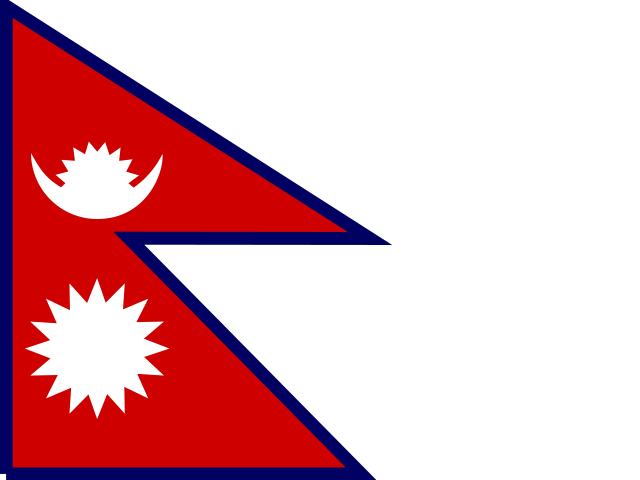
- Region
- Asia · Southern Asia
- Capital
- Kathmandu
- Population
- 29,618,118 (2025)
- Government
- federal parliamentary republic
- Currency
- Nepalese rupee (NPR)
- Official languages
- Nepali
- Spoken languages
- Nepali (official) 44.9%, Maithali 11.1%, Bhojpuri 6.2%, Tharu 5.9%, Tamang 4.9%, Bajjika 3.9%, Avadhi 3%, Nepalbhasha (Newari) 3%, Magar Dhut 2.8%, Doteli 1.7%, Urdu 1.4%, Yakthung/Limbu 1.2%
- Written scripts
- Devanagari
- Area
- 147,181 km²
- Coastline
- Landlocked
- UN member
- Yes
- Affiliations
- IMF, WCO, WTO
- Borders
- China , India
Political stability
59 / 100
Economic stability
53 / 100
Population stability
24 / 100
0–100, higher is more stable. Political: World Bank governance score. Economic: government effectiveness, regulatory quality, and inflation proximity to 2% (World Bank). Population: stability of growth and net migration rates (World Bank).
Trade profile
- Key exports
- knotted carpets, garments, flat-rolled iron, synthetic fibers, palm oil (2023)
- Key imports
- refined petroleum, natural gas, garments, iron reductions, broadcasting equipment (2023)
- Natural resources
- quartz, water, timber, hydropower, scenic beauty, small deposits of lignite, copper, cobalt, iron ore
- Luxury goods
- pashmina
- Primary route
- Indian Ocean services to Asia, the Gulf, and Europe via Suez
- Secondary route
- Bay of Bengal and Arabian Sea feeder networks
The xin.bz view
- Nepal’s Himalayan flood destroyed further capacity on the Gyirong–Rasuwagadhi corridor atop an already constrained northern trade system — commercial freight capacity fell just as humanitarian demand for food, fuel, medicine, and shelter surged.
- Reconstruction creates a second-order demand pulse — cement, steel, machinery, bridge components, hydropower equipment — moving through damaged corridors, with India increasingly important as the alternate supply path.
xin.bz coverage
El Niño Hits China Differently: Beijing Can Move the Shock
China enters El Niño with grain reserves, oil inventories, huge ports, Belt and Road routes, and rare-earth leverage — its purchasing and inventory decisions decide where global disruption lands next.
El Niño Is Tightening the World's Food Valves
India's 90.7M t grain buffer, early Philippine rice buying, Indonesia's B50 palm-oil pull, and Nepal's flood — governments now decide how much food this region releases to the world.
Trade research
- WTO trade profile — tariffs, trade in goods and services, top partners
- World Bank country data — GDP, trade share of GDP, logistics indicators
- OEC trade profile — export/import composition and partners, visualized
- ITC Trade Map — detailed trade statistics by product (ITC/UN Comtrade)
- CIA World Factbook — geography, economy, transportation infrastructure
xin.bz can watch Nepal for you — email alerts when new disruptions hit. Start free
Sources: mledoze/countries (ODbL), CIA World Factbook (public domain), World Bank Open Data (CC BY-4.0), flag-icons (MIT). Stability scores are xin.bz composites of the cited World Bank indicators; routes and commodity notes are xin.bz assessments. Informational only — verify with official sources.