Saudi Arabia
Kingdom of Saudi Arabia
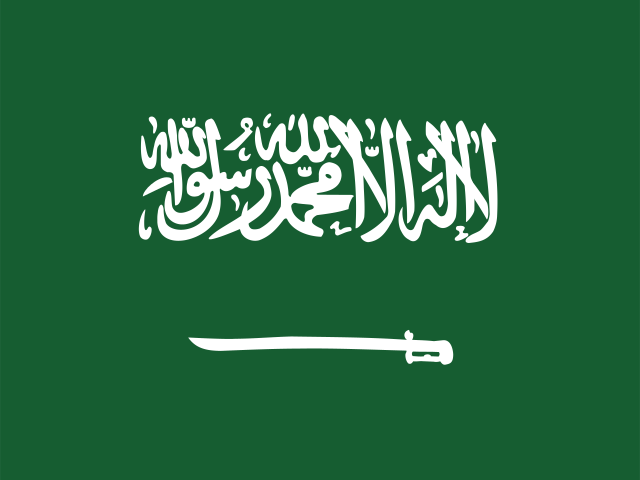
- Region
- Asia · Western Asia
- Capital
- Riyadh
- Population
- 36,973,555 (2025)
- Government
- absolute monarchy
- Currency
- Saudi riyal (SAR)
- Official languages
- Arabic
- Spoken languages
- Arabic (official)
- Written scripts
- Arabic
- Area
- 2,149,690 km²
- Coastline
- Coastal
- UN member
- Yes
- Affiliations
- BRICS, G20, GCC, IMF, Arab League, OIC, OPEC, WCO, WTO
- Borders
- Iraq , Jordan , Kuwait , Oman , Qatar , United Arab Emirates , Yemen
Political stability
65 / 100
Economic stability
77 / 100
Population stability
18 / 100
0–100, higher is more stable. Political: World Bank governance score. Economic: government effectiveness, regulatory quality, and inflation proximity to 2% (World Bank). Population: stability of growth and net migration rates (World Bank).
Trade profile
- Key exports
- crude petroleum, refined petroleum, plastics, alcohols, ships (2023)
- Key imports
- cars, refined petroleum, gold, broadcasting equipment, packaged medicine (2023)
- Natural resources
- petroleum, natural gas, iron ore, gold, copper
- Primary route
- Red Sea gateway (Jeddah) on Asia–Europe lanes
- Secondary route
- Gulf ports (Dammam) serving eastbound trade
The xin.bz view
- Saudi Arabia has engineered water resilience — roughly 16M m³/day of desalination capacity — so El Niño heat becomes an electricity and fuel event, already pulling large volumes of Russian fuel oil into the summer power system.
- It expects ~15M t of cereal imports in 2026/27 and just contracted 661,000 t of wheat spread across Jeddah, Yanbu, and Jazan from multiple origins; Gulf purchasing power at that scale can redirect global grain availability.
- The autumn El Niño window cuts both ways: above-normal rainfall with an October peak improves recharge while raising flash-flood risk for roads, ports, and construction.
xin.bz coverage
El Niño Is Raising the Middle East's Food and Water Needs — While War Is Rewriting How Supply Gets In and Energy Gets Out
Gulf desalination and grain buying, Egypt's Nile and Suez loops, Hormuz fertilizer constraints, and $280B+ in reconstruction demand — the Middle East sits on both sides of the El Niño shock.
The Saudi Bypass Is Gone
Drones from Iraq shut the East-West pipeline, the only overland route around Hormuz. The line took two years to build and a decade to reach 7 million barrels a day. Rapid-repair claims meet parts, people, and security limits, and European refiners have lost their October Saudi crude.
Commodity Deep Dive ·
Fertilizer Converts Energy and Mined Minerals Into Crop Yield — and Its Supply Chain Has Become a Strategic Chokepoint
Fertilizer deep dive — 216M t of nutrients produced against 197M t used, nitrogen tied to natural gas, Hormuz choking a third of urea trade, and why N, P, and K are irreplaceable in plant nutrition.
Trade research
- WTO trade profile — tariffs, trade in goods and services, top partners
- World Bank country data — GDP, trade share of GDP, logistics indicators
- OEC trade profile — export/import composition and partners, visualized
- ITC Trade Map — detailed trade statistics by product (ITC/UN Comtrade)
- CIA World Factbook — geography, economy, transportation infrastructure
xin.bz can watch Saudi Arabia for you — email alerts when new disruptions hit. Start free
Sources: mledoze/countries (ODbL), CIA World Factbook (public domain), World Bank Open Data (CC BY-4.0), flag-icons (MIT). Stability scores are xin.bz composites of the cited World Bank indicators; routes and commodity notes are xin.bz assessments. Informational only — verify with official sources.