Yemen
Republic of Yemen
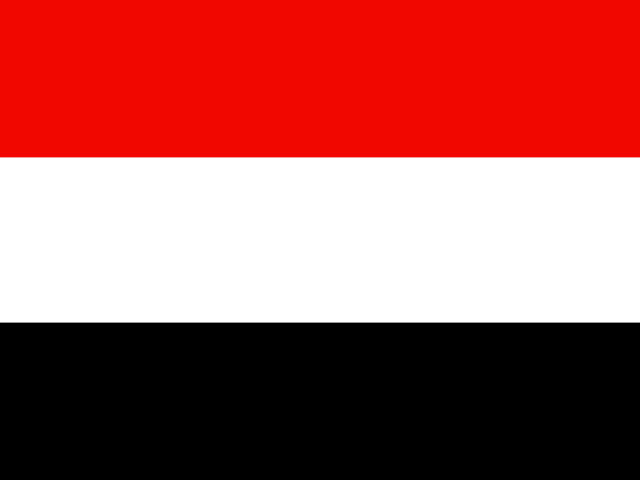
U.S. sanctions — Yemen-related sanctions. Targeted designations, including Houthi-related networks.
As of August 2026 — verify with OFAC and screen counterparties with the xin.bz OFAC search.
- Region
- Asia · Western Asia
- Capital
- Sana'a
- Population
- 41,773,878 (2025)
- Government
- in transition
- Currency
- Yemeni rial (YER)
- Official languages
- Arabic
- Spoken languages
- Arabic (official)
- Written scripts
- Arabic
- Area
- 527,968 km²
- Coastline
- Coastal
- UN member
- Yes
- Affiliations
- IMF, Arab League, OIC, WCO, WTO
- Borders
- Oman , Saudi Arabia
Political stability
19 / 100
Economic stability
21 / 100
Population stability
47 / 100
0–100, higher is more stable. Political: World Bank governance score. Economic: government effectiveness, regulatory quality, and inflation proximity to 2% (World Bank). Population: stability of growth and net migration rates (World Bank).
Trade profile
- Key exports
- gold, fish, scrap iron, shellfish, industrial acids/oils/alcohols (2023)
- Key imports
- wheat, raw sugar, rice, iron bars, plastic products (2023)
- Natural resources
- petroleum, fish, rock salt, marble
- Primary route
- Gulf and Red Sea hubs (Jebel Ali, Jeddah) on Asia–Europe lanes
- Secondary route
- Suez Canal corridor to the Mediterranean
The xin.bz view
- Yemen needs roughly 5.2M t of cereal imports in 2026; food cargo keeps arriving but fuel is constrained, and scarce diesel raises trucking, milling, and distribution costs — food security here is a freight problem after the vessel docks.
xin.bz coverage
El Niño Is Raising the Middle East's Food and Water Needs — While War Is Rewriting How Supply Gets In and Energy Gets Out
Gulf desalination and grain buying, Egypt's Nile and Suez loops, Hormuz fertilizer constraints, and $280B+ in reconstruction demand — the Middle East sits on both sides of the El Niño shock.
El Niño Is Splitting Africa's Water Map — Just as the World Turns to the Continent for Food, Fertilizer, Fuel and Critical Minerals
A wetter Horn and a drier south, Southern Africa's grain and Kariba buffers, cocoa's port squeeze, Moroccan phosphate and Nigerian fuel as global substitutes, and the corridors that turn African resources into accessible supply.
The Saudi Bypass Is Gone
Drones from Iraq shut the East-West pipeline, the only overland route around Hormuz. The line took two years to build and a decade to reach 7 million barrels a day. Rapid-repair claims meet parts, people, and security limits, and European refiners have lost their October Saudi crude.
Trade research
- WTO trade profile — tariffs, trade in goods and services, top partners
- World Bank country data — GDP, trade share of GDP, logistics indicators
- OEC trade profile — export/import composition and partners, visualized
- ITC Trade Map — detailed trade statistics by product (ITC/UN Comtrade)
- CIA World Factbook — geography, economy, transportation infrastructure
xin.bz can watch Yemen for you — email alerts when new disruptions hit. Start free
Sources: mledoze/countries (ODbL), CIA World Factbook (public domain), World Bank Open Data (CC BY-4.0), flag-icons (MIT). Stability scores are xin.bz composites of the cited World Bank indicators; routes and commodity notes are xin.bz assessments. Informational only — verify with official sources.