United Arab Emirates
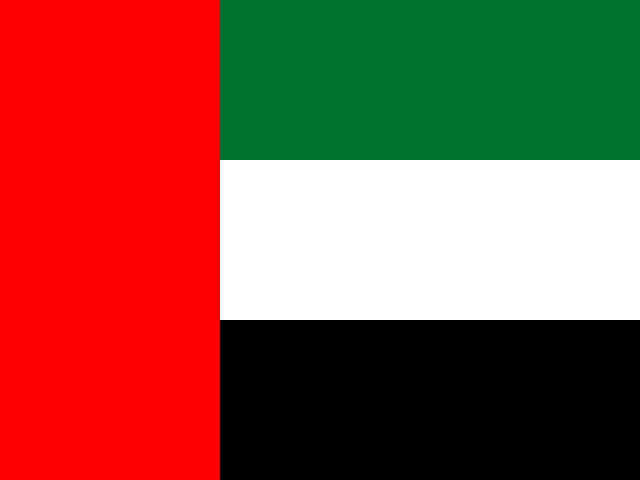
- Region
- Asia · Western Asia
- Capital
- Abu Dhabi
- Population
- 11,513,149 (2025)
- Government
- federation of monarchies
- Currency
- United Arab Emirates dirham (AED)
- Official languages
- Arabic
- Spoken languages
- Arabic (official), English, Hindi, Malayalam, Urdu, Pashto, Tagalog, Persian
- Written scripts
- Arabic
- Area
- 83,600 km²
- Coastline
- Coastal
- UN member
- Yes
- Affiliations
- BRICS, GCC, IMF, Arab League, OIC, OPEC, WCO, WTO
- Borders
- Oman , Saudi Arabia
Political stability
79 / 100
Economic stability
75 / 100
Population stability
3 / 100
0–100, higher is more stable. Political: World Bank governance score. Economic: government effectiveness, regulatory quality, and inflation proximity to 2% (World Bank). Population: stability of growth and net migration rates (World Bank).
Trade profile
- Key exports
- crude petroleum, refined petroleum, gold, broadcasting equipment, natural gas (2023)
- Key imports
- gold, broadcasting equipment, cars, refined petroleum, diamonds (2023)
- Natural resources
- petroleum, natural gas
- Luxury goods
- gold and jewelry (re-export hub)
- Primary route
- Jebel Ali — the Gulf’s transshipment hub on Asia–Europe lanes
- Secondary route
- Air-cargo hub corridors (Dubai) and Red Sea connections
The xin.bz view
- Dubai’s Hassyan reverse-osmosis project reaches full operation in Q1 2027, adding major desalination capacity mid-cycle, while the August halt of UAE trade and financial transactions with Iran closed one of the region’s key logistics and payments gateways.
xin.bz coverage
El Niño Is Raising the Middle East's Food and Water Needs — While War Is Rewriting How Supply Gets In and Energy Gets Out
Gulf desalination and grain buying, Egypt's Nile and Suez loops, Hormuz fertilizer constraints, and $280B+ in reconstruction demand — the Middle East sits on both sides of the El Niño shock.
The Fuel Dock Becomes the Next Shipping Chokepoint
Large-vessel bunker constraints are moving from refinery systems into global freight economics — a 218,000 b/d fuel-oil deficit, 12–15-day Singapore lead times, and the routes, industries and carriers that pay first.
DR Congo's Ebola Supply Line Is Stretching From Entebbe to the Clinic Door
More than 2,000 tonnes of Ebola supplies have moved into eastern DR Congo through Entebbe and Bunia. A new strain, a 14-day vaccine clock, the rains, unpaid staff and a divided east decide how much reaches the clinics.
Future Insight ·
Rearming the World Is Becoming a Race for Explosives, Factories, Critical Minerals, and Trusted Supply Chains
Future Insights deep dive — the 2026–2032 global rearmament cycle: a ~2.6 million tonne military replacement obligation, and the industrial race in explosives, propellant, rare-earth magnets, and trusted supply chains.
Future Insight ·
Two Programs, One Ridge: The Supply Chain That Decides the Moon Race, 2024–2036
Future Insights — the second Moon race as a logistics contest: $93 billion spent, more than 10 tanker flights per landing, and two programs aimed at the same sunlit ridge above a crater that has been dark for billions of years.
Trade research
- WTO trade profile — tariffs, trade in goods and services, top partners
- World Bank country data — GDP, trade share of GDP, logistics indicators
- OEC trade profile — export/import composition and partners, visualized
- ITC Trade Map — detailed trade statistics by product (ITC/UN Comtrade)
- CIA World Factbook — geography, economy, transportation infrastructure
xin.bz can watch United Arab Emirates for you — email alerts when new disruptions hit. Start free
Sources: mledoze/countries (ODbL), CIA World Factbook (public domain), World Bank Open Data (CC BY-4.0), flag-icons (MIT). Stability scores are xin.bz composites of the cited World Bank indicators; routes and commodity notes are xin.bz assessments. Informational only — verify with official sources.