Ethiopia
Federal Democratic Republic of Ethiopia
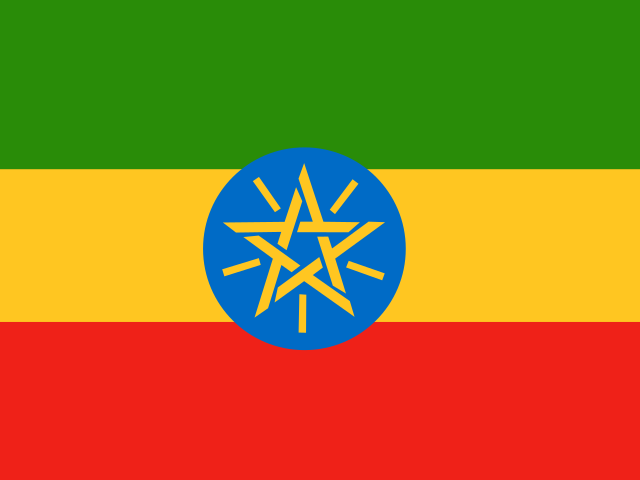
- Region
- Africa · Eastern Africa
- Capital
- Addis Ababa
- Population
- 135,472,051 (2025)
- Government
- federal parliamentary republic
- Currency
- Ethiopian birr (ETB)
- Official languages
- Amharic
- Spoken languages
- Oromo (official regional working language) 33.8%, Amharic (official national language) 29.3%, Somali (official regional working language) 6.2%
- Written scripts
- Ethiopic
- Area
- 1,104,300 km²
- Coastline
- Landlocked
- UN member
- Yes
- Affiliations
- African Union, BRICS, COMESA, IMF, WCO, WTO (accession candidate)
- Borders
- Djibouti , Eritrea , Kenya , Somalia , South Sudan , Sudan
Political stability
34 / 100
Economic stability
30 / 100
Population stability
54 / 100
0–100, higher is more stable. Political: World Bank governance score. Economic: government effectiveness, regulatory quality, and inflation proximity to 2% (World Bank). Population: stability of growth and net migration rates (World Bank).
Trade profile
- Key exports
- coffee, garments, dried legumes, cut flowers, oil seeds (2023)
- Key imports
- refined petroleum, fertilizers, plastics, raw sugar, cars (2023)
- Natural resources
- small reserves of gold, platinum, copper, potash, natural gas, hydropower
- Luxury goods
- specialty coffee
- Primary route
- Indian Ocean gateways (Mombasa, Dar es Salaam, Djibouti) to Asia and the Gulf
- Secondary route
- Suez corridor to Europe
The xin.bz view
- Ethiopia enters a favorable rainfall window with ~7M t of wheat expected (plus ~1.4M t of imports) and expanding coffee exports — but ~96.7% of its maritime cargo moves through Djibouti, tying East African weather to Red Sea security.
- It is the world’s sixth-largest sorghum producer (4.1M t forecast for 2026/27) — a domestic food-security crop where rainfall and road access matter more than world prices.
xin.bz coverage
El Niño Is Splitting Africa's Water Map — Just as the World Turns to the Continent for Food, Fertilizer, Fuel and Critical Minerals
A wetter Horn and a drier south, Southern Africa's grain and Kariba buffers, cocoa's port squeeze, Moroccan phosphate and Nigerian fuel as global substitutes, and the corridors that turn African resources into accessible supply.
Commodity Deep Dive ·
Sorghum Is the Drought-Tolerant Grain Linking Food Security to U.S.–China Feed Trade
Sorghum deep dive — the U.S. supplies 50.6% of world exports and China takes 77.6% of imports, Kansas and Texas hold 82% of the U.S. crop, and one month of Plains drought cut USDA's forecast 22%.
Trade research
- WTO trade profile — tariffs, trade in goods and services, top partners
- World Bank country data — GDP, trade share of GDP, logistics indicators
- OEC trade profile — export/import composition and partners, visualized
- ITC Trade Map — detailed trade statistics by product (ITC/UN Comtrade)
- CIA World Factbook — geography, economy, transportation infrastructure
xin.bz can watch Ethiopia for you — email alerts when new disruptions hit. Start free
Sources: mledoze/countries (ODbL), CIA World Factbook (public domain), World Bank Open Data (CC BY-4.0), flag-icons (MIT). Stability scores are xin.bz composites of the cited World Bank indicators; routes and commodity notes are xin.bz assessments. Informational only — verify with official sources.