Egypt
Arab Republic of Egypt
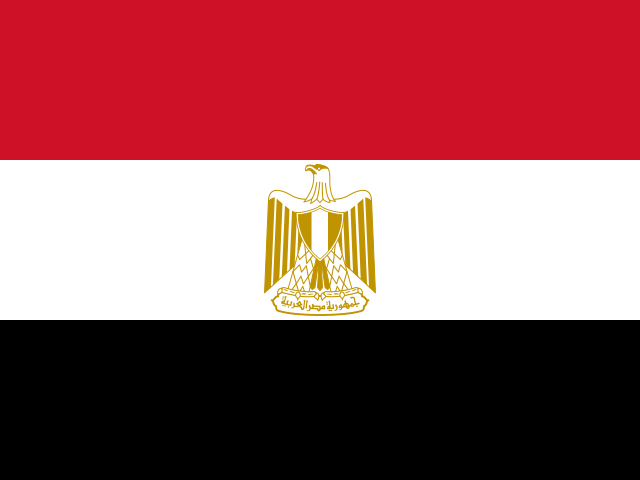
- Region
- Africa · Northern Africa
- Capital
- Cairo
- Population
- 118,365,995 (2025)
- Government
- presidential republic
- Currency
- Egyptian pound (EGP)
- Official languages
- Arabic
- Spoken languages
- Arabic (official); English and French widely understood by educated classes
- Written scripts
- Arabic
- Area
- 1,002,450 km²
- Coastline
- Coastal
- UN member
- Yes
- Affiliations
- African Union, BRICS, COMESA, IMF, Arab League, OIC, WCO, WTO
- Borders
- Israel , Libya , Palestine , Sudan
Political stability
49 / 100
Economic stability
35 / 100
Population stability
69 / 100
0–100, higher is more stable. Political: World Bank governance score. Economic: government effectiveness, regulatory quality, and inflation proximity to 2% (World Bank). Population: stability of growth and net migration rates (World Bank).
Trade profile
- Key exports
- refined petroleum, natural gas, fertilizers, garments, crude petroleum (2023)
- Key imports
- refined petroleum, wheat, plastics, natural gas, packaged medicine (2023)
- Natural resources
- petroleum, natural gas, iron ore, phosphates, manganese, limestone, gypsum, talc, asbestos, lead, rare earth elements, zinc
- Primary route
- The Suez Canal — Asia–Europe interoceanic transit (Port Said, Suez)
- Secondary route
- Mediterranean and Red Sea feeder networks
The xin.bz view
- Egypt runs two feedback loops at once: ~29M t of cereal imports (13.5M t wheat) against a ~10M t domestic crop tie its food bill to Black Sea supply, while Suez revenue (~$4.67B in FY2025/26) rises and falls with the same Red Sea security that sets its import freight costs.
- Its water arrives from upstream — East African rainfall, Blue Nile flows, and GERD operations matter more than domestic weather; August flows ran below average before Ethiopian highland rainfall strengthened late in the month.
xin.bz coverage
El Niño Is Raising the Middle East's Food and Water Needs — While War Is Rewriting How Supply Gets In and Energy Gets Out
Gulf desalination and grain buying, Egypt's Nile and Suez loops, Hormuz fertilizer constraints, and $280B+ in reconstruction demand — the Middle East sits on both sides of the El Niño shock.
Africa Is Building a Continental Trade System in Real Time: AfCFTA Moves From Treaty to Customs Gates, Payment Rails and Freight Corridors
AfCFTA's implementation era in 2026 — customs modernization, PAPSS payment expansion, the Abidjan-Lagos and Lobito corridors, and the regional manufacturing buildout reshaping intra-African trade.
The Fuel Dock Becomes the Next Shipping Chokepoint
Large-vessel bunker constraints are moving from refinery systems into global freight economics — a 218,000 b/d fuel-oil deficit, 12–15-day Singapore lead times, and the routes, industries and carriers that pay first.
The Saudi Bypass Is Gone
Drones from Iraq shut the East-West pipeline, the only overland route around Hormuz. The line took two years to build and a decade to reach 7 million barrels a day. Rapid-repair claims meet parts, people, and security limits, and European refiners have lost their October Saudi crude.
Commodity Deep Dive ·
Wheat Is the Grain That Feeds a Fifth of Humanity's Calories — and a Quarter of Its Exports Leave Through One 700-Metre Channel
Wheat deep dive — 822.4 Mt of world production against 211.7 Mt of trade, China at 140.1 Mt, Russia exporting 43.0 Mt through the Turkish Straits, and CBOT nearby wheat at $7.26 a bushel.
Future Insight ·
Two Programs, One Ridge: The Supply Chain That Decides the Moon Race, 2024–2036
Future Insights — the second Moon race as a logistics contest: $93 billion spent, more than 10 tanker flights per landing, and two programs aimed at the same sunlit ridge above a crater that has been dark for billions of years.
Trade research
- WTO trade profile — tariffs, trade in goods and services, top partners
- World Bank country data — GDP, trade share of GDP, logistics indicators
- OEC trade profile — export/import composition and partners, visualized
- ITC Trade Map — detailed trade statistics by product (ITC/UN Comtrade)
- CIA World Factbook — geography, economy, transportation infrastructure
xin.bz can watch Egypt for you — email alerts when new disruptions hit. Start free
Sources: mledoze/countries (ODbL), CIA World Factbook (public domain), World Bank Open Data (CC BY-4.0), flag-icons (MIT). Stability scores are xin.bz composites of the cited World Bank indicators; routes and commodity notes are xin.bz assessments. Informational only — verify with official sources.