Guinea
Republic of Guinea
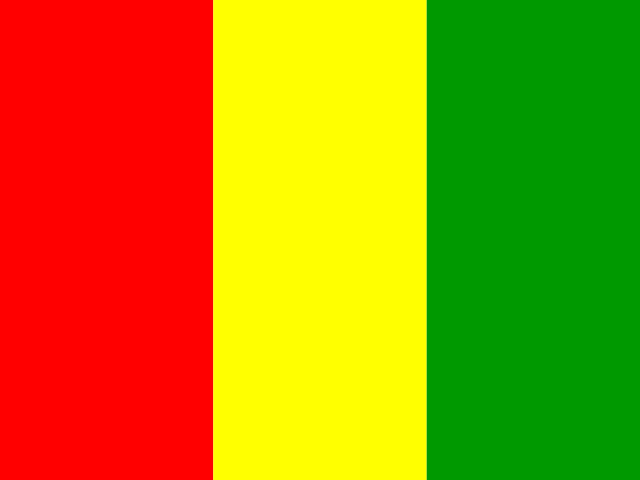
- Region
- Africa · Western Africa
- Capital
- Conakry
- Population
- 15,099,727 (2025)
- Government
- presidential republic
- Currency
- Guinean franc (GNF)
- Official languages
- French
- Spoken languages
- French (official), Pular, Maninka, Susu, other native languages
- Written scripts
- Latin
- Area
- 245,857 km²
- Coastline
- Coastal
- UN member
- Yes
- Affiliations
- IMF, OIC, WCO, WTO
- Borders
- Ivory Coast , Guinea-Bissau , Liberia , Mali , Senegal , Sierra Leone
Political stability
48 / 100
Economic stability
43 / 100
Population stability
46 / 100
0–100, higher is more stable. Political: World Bank governance score. Economic: government effectiveness, regulatory quality, and inflation proximity to 2% (World Bank). Population: stability of growth and net migration rates (World Bank).
Trade profile
- Key exports
- gold, aluminum ore, cocoa beans, crude petroleum, coconuts/brazil nuts/cashews (2023)
- Key imports
- refined petroleum, rice, garments, construction vehicles, cars (2023)
- Natural resources
- bauxite, iron ore, diamonds, gold, uranium, hydropower, fish, salt
- Critical minerals
- World’s largest bauxite reserves; major exporter.
- Primary route
- Gulf of Guinea ports (Lagos, Tema, Abidjan) to Europe
- Secondary route
- South Atlantic services to Asia via the Cape of Good Hope
xin.bz coverage
Vessel-Days Are Becoming the Scarce Asset in Global Shipping
The merchant fleet is growing while effective capacity tightens — Hormuz detours, Panama slot cuts, war-risk insurance, officer shortages and drydocking are consuming the ship-days that move cargo.
Future Insight ·
The AI Factory Becomes an Industrial Commodity Complex — How Data Centers Reshape Cooling, Water, Power, Metals, and Global Trade Through 2050
Future Insights deep dive — how AI data centers reshape global demand for copper, transformers, cooling equipment, waste heat, and grid capacity through 2050, and what it means for global trade.
Trade research
- WTO trade profile — tariffs, trade in goods and services, top partners
- World Bank country data — GDP, trade share of GDP, logistics indicators
- OEC trade profile — export/import composition and partners, visualized
- ITC Trade Map — detailed trade statistics by product (ITC/UN Comtrade)
- CIA World Factbook — geography, economy, transportation infrastructure
xin.bz can watch Guinea for you — email alerts when new disruptions hit. Start free
Sources: mledoze/countries (ODbL), CIA World Factbook (public domain), World Bank Open Data (CC BY-4.0), flag-icons (MIT). Stability scores are xin.bz composites of the cited World Bank indicators; routes and commodity notes are xin.bz assessments. Informational only — verify with official sources.