Tuvalu
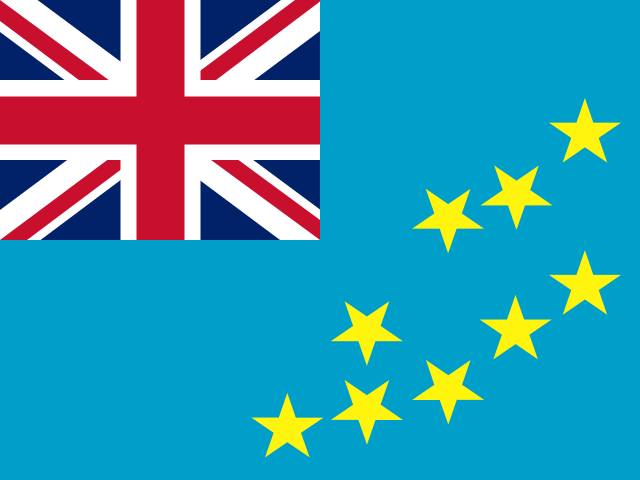
- Region
- Oceania · Polynesia
- Capital
- Funafuti
- Population
- 9,492 (2025)
- Government
- parliamentary democracy under a constitutional monarchy; a Commonwealth realm
- Currencies
- Australian dollar (AUD), Tuvaluan dollar (TVD)
- Official languages
- English, Tuvaluan
- Spoken languages
- Tuvaluan (official), English (official), Samoan, Kiribati (on the island of Nui)
- Written scripts
- Latin
- Area
- 26 km²
- Coastline
- Coastal
- UN member
- Yes
- Affiliations
- IMF
Political stability
91 / 100
Economic stability
48 / 100
Population stability
2 / 100
0–100, higher is more stable. Political: World Bank governance score. Economic: government effectiveness, regulatory quality, and inflation proximity to 2% (World Bank). Population: stability of growth and net migration rates (World Bank).
Trade profile
- Key exports
- fish (2023)
- Key imports
- ships, refined petroleum, iron structures, fish, hand tools (2023)
- Natural resources
- fish, coconut (copra)
- Primary route
- Feeder services to New Zealand and U.S. West Coast
- Secondary route
- Regional inter-island connections via Fiji and Tahiti
The xin.bz view
- Tuvalu sits on the wetter central-equatorial side of the El Niño split — drainage and water capture matter now, and shifting tuna effort can move licensing revenue toward its waters.
xin.bz coverage
El Niño Is Redrawing the Pacific's Water and Fishery Map — Just as Oceania Becomes More Valuable to Global Food, Energy and Critical-Mineral Supply
Australia's 28M t wheat crop and El Niño fire signature, Pacific islands splitting into dry west and wet center, tuna revenue moving between EEZs, New Zealand's west–east water divide, and Australian LNG and rare earths gaining strategic value.
Trade research
- WTO trade profile — tariffs, trade in goods and services, top partners
- World Bank country data — GDP, trade share of GDP, logistics indicators
- OEC trade profile — export/import composition and partners, visualized
- ITC Trade Map — detailed trade statistics by product (ITC/UN Comtrade)
- CIA World Factbook — geography, economy, transportation infrastructure
xin.bz can watch Tuvalu for you — email alerts when new disruptions hit. Start free
Sources: mledoze/countries (ODbL), CIA World Factbook (public domain), World Bank Open Data (CC BY-4.0), flag-icons (MIT). Stability scores are xin.bz composites of the cited World Bank indicators; routes and commodity notes are xin.bz assessments. Informational only — verify with official sources.