Namibia
Republic of Namibia
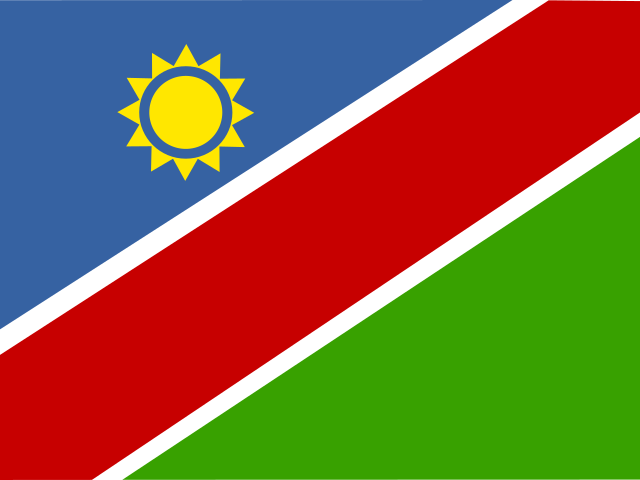
- Region
- Africa · Southern Africa
- Capital
- Windhoek
- Population
- 3,092,816 (2025)
- Government
- presidential republic
- Currencies
- Namibian dollar (NAD), South African rand (ZAR)
- Official languages
- Afrikaans, English, German, Herero, Khoekhoe, Kwangali, Lozi, Ndonga, Tswana
- Spoken languages
- Oshiwambo languages 49.7%, Nama/Damara 11%, Kavango languages 10.4%, Afrikaans 9.4%, Herero languages 9.2%, Zambezi languages 4.9%, English (official) 2.3%, other African languages 1.5%
- Written scripts
- Latin
- Area
- 825,615 km²
- Coastline
- Coastal
- UN member
- Yes
- Affiliations
- African Union, IMF, SADC, WCO, WTO
- Borders
- Angola , Botswana , South Africa , Zambia
Political stability
75 / 100
Economic stability
56 / 100
Population stability
54 / 100
0–100, higher is more stable. Political: World Bank governance score. Economic: government effectiveness, regulatory quality, and inflation proximity to 2% (World Bank). Population: stability of growth and net migration rates (World Bank).
Trade profile
- Key exports
- gold, diamonds, radioactive chemicals, fish, refined petroleum (2023)
- Key imports
- refined petroleum, copper ore, ships, electricity, trucks (2023)
- Natural resources
- diamonds, copper, uranium, gold, silver, lead, tin, lithium, cadmium, tungsten, zinc, salt
- Critical minerals
- Major uranium supplier.
- Luxury goods
- diamonds
- Primary route
- Durban and Cape corridor to Asia and Europe
- Secondary route
- Regional overland corridors to inland markets
The xin.bz view
- Namibia’s Orange Basin keeps drawing majors — Equinor joining Chevron and QatarEnergy on an offshore licence — extending Africa’s Atlantic energy frontier south, while the SADC outlook leaves it on the drier side of the split.
xin.bz coverage
El Niño Is Splitting Africa's Water Map — Just as the World Turns to the Continent for Food, Fertilizer, Fuel and Critical Minerals
A wetter Horn and a drier south, Southern Africa's grain and Kariba buffers, cocoa's port squeeze, Moroccan phosphate and Nigerian fuel as global substitutes, and the corridors that turn African resources into accessible supply.
Future Insight ·
The AI Factory Becomes an Industrial Commodity Complex — How Data Centers Reshape Cooling, Water, Power, Metals, and Global Trade Through 2050
Future Insights deep dive — how AI data centers reshape global demand for copper, transformers, cooling equipment, waste heat, and grid capacity through 2050, and what it means for global trade.
Trade research
- WTO trade profile — tariffs, trade in goods and services, top partners
- World Bank country data — GDP, trade share of GDP, logistics indicators
- OEC trade profile — export/import composition and partners, visualized
- ITC Trade Map — detailed trade statistics by product (ITC/UN Comtrade)
- CIA World Factbook — geography, economy, transportation infrastructure
xin.bz can watch Namibia for you — email alerts when new disruptions hit. Start free
Sources: mledoze/countries (ODbL), CIA World Factbook (public domain), World Bank Open Data (CC BY-4.0), flag-icons (MIT). Stability scores are xin.bz composites of the cited World Bank indicators; routes and commodity notes are xin.bz assessments. Informational only — verify with official sources.